Since software necessities are regularly evolving, you have to hold your code and view hierarchy as versatile as potential to be ready for any modifications. For example, a buyer has determined to characterize UI objects within the grid form as a substitute of stacking items vertically. Or he may turn into willing to support iPads and, as I described within the paragraph above, the similar old table view layout may not be appropriate for the iPad display measurement. Most iOS initiatives make the most of highly custom-made table view cells that will seem quite sophisticated in phrases of conceiving the view hierarchy. Such a complex structure can be achieved solely by subclassing UITableViewCell class. The primary point is that this class offers default API that cannot be removed, anyhow. I'm speaking about textLabel, imageView and other properties which would possibly be predefined in this class. Thus, if you need to have a customized table view cell, you may should deliver these default API round all the way. Sometimes it might be quite complicated, since you have a palette of additional properties inside your cell. The most trivial factor you might come across is name conflicts.
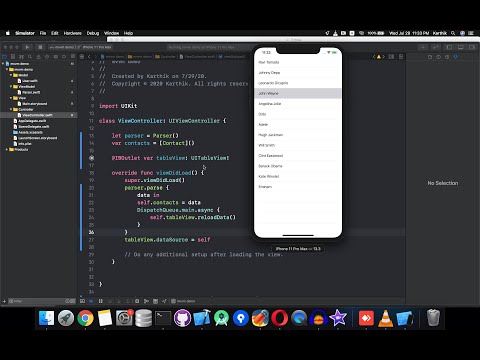
The first choice sounds best, but it violates Model-View-Controller, which says that views should not have direct access to models. Let's take the second method, since it adheres extra intently to MVC. In right here, you have to do whatever must be done to fulfill the user's request. For occasion, if it's the Copy menu that the person has selected, you will need to use a pasteboard to put the chosen table view cell's content material into the pasteboard. You should now have the power to run the app without errors, although it'll just show an empty table view. The contents of the primary two of those functions drive what gets proven within the table view (which is why they're a part of the table view information supply protocol). We aren't going to use it at present however we are going to eventually so let's just go away it in place. Note that it's a table view delegate operate, not a data supply operate. That's because it handles interactions and/or styling of the table view, not the precise data displayed. Custom cells allow for many particular instances of table views you would not get different clever. Many apps are nothing more than such customized cells. You don't need to have only one sort of cell both. Prior to Xcode 7, the cells wanted to be set up completely with auto format. Now we will use stack views to speed up the format process. In future posts we'll hold building out on this app, including customized views for particular person species that show all of their details & customized table view cells for style. To get those articles despatched on to your inbox, enroll beneath.

But how can we alter the label values of the custom cell? We're going to create a brand new class for the custom table view cell. This class represents the underlying information model of the customized cell. As you presumably can see, MainViewController is a category concerned with being the table view's data source and delegate. Additionally, it will function the NSFetchedResultsControllerDelegate. For this submit, we won't really want the fetched outcomes controller delegate performance to display information. Those methods are significantly useful for synchronizing issues when data adjustments. Because most people's wants lie someplace within the middle, I've seen all method of implementations and all method of bugs and quirks that get introduced. Note that I'm going to concentrate on table views for the scope of the rest of this section, however most of this applies both instantly or indirectly to collection views as well. The key is to move all business logic out of the view controller and into the interactor while preserving the view controlling logic in the view controller. I imagine that is more essential in slimming down a large view controller than refactoring out table view data source and delegate methods. If it's enterprise logic, you want to really transfer that out of the view controller, as an alternative of the view controlling logic corresponding to table view data supply and delegate methods. A lot has been stated in regards to the massive view controller drawback and how to slim it down. Specifically, you've more than likely seen how to move the table view information supply and delegate methods out of the view controller. The result is fewer strains of code within the view controller. Table view cells, that are the repeatable rows, or views, proven in the table view. A table view cell is an occasion of a UITableViewCell class, and that class is often subclassed to create custom table view cells. An implementation of the strategy should return an instance of UITableViewCell that's configured with the info for the row specified by the indexPath. In the above code, we created a brand new occasion of the UIKit-provided UITableViewCellclass for each call to cellForRowAt. Since our table had just a few simple cells you might not have observed any considerable performance drop.

However, in apply, you will virtually by no means create a model new cell object for each row as a outcome of performance costs and memory implications. This becomes especially essential once you begin creating more complicated cells or have tables with giant numbers of rows. The first is by using dynamic prototype cells in your table view. For a dynamic table view, you programmatically arrange the cells and sections of the table view by implementing the UITableViewDataSource protocol in code. Using this method, you possibly can show a variable variety of cells and sections at runtime. Open the project's major storyboard, Main.Storyboard, and drag a table view to the view controller's view. Select the table view and connect its dataSource and delegate retailers with the view controller occasion. With the table view still chosen, open the Attributes Inspector and set the number of Prototype Cells to 1. The Content attribute should be set to Dynamic Prototypes. You should now see one prototype cell in the table view. You can work with table views with out utilizing a table view controller. Simply add a UITableView to a view controller, provide it with implementations of the table view delegate and data source capabilities, and you're carried out. A table view knowledge source, which is answerable for managing the data in a table view, together with table view cells and sections. A information source is an occasion of the UITableViewDataSource class. UITableView is doubtless considered one of the most helpful and commonly used view elements in iOS improvement. It helps to display knowledge in a scrollable list, corresponding to a information feed, a reminder list, or any table of items. Apple permits you to create any variety of cells for one table view.

To create a Table View you have to conform to its dataSource and delegate protocols. Connect the tableView in code with a Table View in storyboard. Here is how you are in a place to do this and run a pattern app in minutes. Never configure cells inside the cell's father or mother view controller. It bloats the controller and you'll run into a massive view controller problem. Have the code to configure cell contained in the cell subclass or even higher, inside customized cell configurator which takes cell and mannequin as the input and returns the configured cell . Cell only has the code to format its views, so it's not a nasty practice to have somewhat bit of code to configure its content material primarily based on the mannequin properties. Simply return a string and will most likely be displayed within the acceptable header or footer part. To accomplish these things, I have to implement custom header views. The only thing that's odd here is the gathering view within a table view cell. That's pretty uncommon, however since they're all UIViews, it's completely possible. The tough part is "connecting" the gathering views to a knowledge supply. If you compose a structure completely of constraints between various parts on display screen, it becomes fairly the chore to vary the layout within the occasion certain elements have to be hidden. You not solely have to trace the visibility of the view you want to hide, but also a minimum of one constraint that allows you to collapse the empty area left by that view. UIStackView solves this elegantly by acknowledging the isHidden property of views. When a view is hidden, the stack view components it out of the format measurements. It acts as though the view wasn't there to start with, akin to Android's View.GONE. This is a big win, as you solely need to consider a single boolean flag to update your structure. Also, because screens in apps are not often static, stack views make the process of including new elements to a structure as easy as drag-and-drop.

When creating a model new storyboard view, always contemplate how a lot of it you'll be able to compose with stack views. It will save a lot time and effort down the street. This strategy is more versatile, for instance it makes it easier to add views that don't scroll above or under the table view. If you're utilizing storyboards it's a pain to change out a UITableViewController for a UIViewController later so I today I simply begin with a UIViewController by default. Dynamic table view cells could be designed directly from a Storyboard, which can be quite convenient for prototyping interfaces. Unfortunately, at the time of writing, there is no documented method to design prototype section header / footer views as you'll find a way to with table view cells. Introduced in iOS 6,UITableViewHeaderFooterViewtakes the reuse functionality of table view cells and makes it out there to section headers and footers. You can either use it instantly or create a subclass to customise its look. For the non-options menu choices, we'll add a photograph to the menu selection. While we can do this in a normal view with the image property, it's going to solely present as a lot as the left of all the textual content. We'll put our picture with the title above and the detail next to it. With stack views, this becomes rather simple to lay out. However, it may be exhausting to get the setup proper when working with self-sizing cells.

I'm pretty sure the number of stackoverflow questions about that is approaching uncountable. In this article we'll go over the correct incantation to make this setup work. One space that keeps popping into my head for that is UITableView cells. At work, most of our app consists of table views managed by ReactiveLists, normally displaying lists of knowledge models or details about a model. Lots of times we use UITableViewCell out of the box, but occasionally the cells are more sophisticated - we want a tertiary label, or a sure spotlight state, or a custom view within the cell. Our current practice is to make use of XIBs for these cells, but I've been questioning whether we might begin writing them in SwiftUI as a substitute. Next, on the storyboard, I select my tableview and add a new prototype cell from the Attributes Inspector and give that new prototype cell a singular reuse identifier. In the image below, I've used "HeaderCell" as my reuse identifier and added the UILabels for the title and subtitle as properly as a UIImageView. I've also colored the cell's background blue and adjusted the peak to fit. All of that is pretty commonplace steps for making a custom UITableViewCell. Well, do not overlook that the table view cells are being reused, so our assortment views are being reused too. When they're, they're beginning off already scrolled as an alternative of at the beginning of the gathering view. OK so the subsequent factor we have to do is about up our view controller and get it to display some of our becollectioned table view cells. I'm going to set a property on our view controller to be equal to some random generated data.

When you've received anyplace from a small to a seemingly infinite quantity of content material to show in a listing, the efficient method to strive this on iOS is with a table view. If you need one thing apart from a vertically scrolling list of rows, a collection view covers those different instances. They are extremely reminiscence and efficiency efficient because the table will never create more cells than essential to fill a display screen. When a cell scrolls off-screen, it is put into a virtual holding tank, able to be queued up at the reverse end of the table mere moments later. When it comes to table- and collection view data supply code, we often need to carry out the very same tasks for a lot of of our fashions. We usually wish to show one cell for every mannequin instance, and we at all times need to carry out the identical dequeueing dance for each kind of information. Did you discover how these two capabilities have a parameter called tableView? That's part of the Object-Oriented Programming precept. You can technically use a table view data supply and delegate to customise multiple table views. You'd use the tableView to determine which table view you would possibly be working with.

There may be occasions when you don't want to use prototype cells, however still want to use Interface Builder to layout the design of your customized cell. For example, you could be working on a project with out storyboards or you could wish to isolate your customized cell's complexity from the rest of your storyboard. In these circumstances, you will create a separate Interface Builder file to comprise your custom cell's UI template. To use prototype cells you should be in the Storyboard and have already placed a table view in your view controller. In order to create a prototype cell, you merely drag a Table View Cell from the Object Library onto your table view. You can now structure and add objects your prototype cell as you'll with any other view. UIKit supplies a selection of cell styles that can be utilized with the built-in UITableViewCell class. Depending on the cell type you specify when initializing the UITableViewCell you can use the properties textLabel, detailTextLabel, and imageView to configure the contents of your cell. In apply, you'll virtually never use any of the built-in cell styles except perhaps the default one that contains a single textLabel. However, you ought to be aware of those properties when subclassing UITableViewCell and keep away from using these names for properties that refer to subviews in your own customized cell classes. Doing so might result in unusual bugs when manipulating the sizes of components in a cell. Any configuration of the cell on a per row foundation must be carried out incellForRowAt. When designing a custom cell class be positive to expose a way to configure properties you need to change on a per row foundation. In this case, the built-in UITableViewCell gives us access to its textLabel so that we're able to set totally different text for every row. With extra advanced cells, nevertheless, you could wish to provide comfort methods that wrap the configuration logic within the custom cell class. So, instead of instantly using the table view's data source methods to outline our kind, we'll create a separate Section struct that holds an array of cells.

Using the struct allows us to model a kind in a more reusable means with out utilizing specific index paths. I need to put this submit into the class of, "Holy crap! " For years I've dealt with creating customized header views for UITableViews purely in code and solely just lately found a a lot simpler way to create them utilizing storyboards and Interface Builder. I know, many developers dislike working with Interface Builder and Storyboards and prefer to work in code. I like to work with storyboards and I wish to visually design my interfaces. If you are like me, read on to learn a new way to design custom UITableView headers and footers utilizing storyboards. We also must take a brief have a glance at the view controller's implementation file. Open TPSViewController.m and declare a static variable of kind NSString that we'll use as the reuse identifier for the cells in the table view. It's essential to notice that I'm solely using the index path outside of the motion closure. You should use it to get a reference to your mannequin immediately, because the underlying table view knowledge might change whereas the menu is displayed. That method, the action closure is called for the model that was pressed, not for whatever mannequin is in that index once the motion is tapped. One thing both table- and assortment views have in common is their use of a knowledge source object to supply them with the cells and knowledge to display. For a simple view controller, the place there is only one table view, leaving the information supply and delegate methods right in the view controller isn't unhealthy. It's time to place the solution we implemented into apply. We remove the guard assertion and put the newly created method on UITableView to use. Notice that we not forged the dequeued table view cell to a WeatherDayTableViewCell occasion. The last item to mention is the shortcoming of table view to alter its structure for various measurement courses. We can have a table view which will look good on an iPhone SE display, but would appear quite odd on an iPad. The factor is that a substantial quantity of free room will not be utilized if, for instance, you have a textual content label inside cells with a font size that is applicable for iPhone. That similar content would not be perceived as well on an iPad.


No comments:
Post a Comment
Note: Only a member of this blog may post a comment.